
The Second Law of Thermodynamics states that the total entropy of an isolated system can never decrease over time, implying that the universe is moving toward a state of maximum entropy or disorder. This law highlights a finite amount of usable energy in the universe, affirming its finitude. In contrast, God selfidentifies as the “I AM” (Exodus 3:14), the eternal, self-sustaining creator and sustainer of all dimensions. This article explores the interplay between these concepts and the profound theological
and existential implications of sin, death, and eternal life.
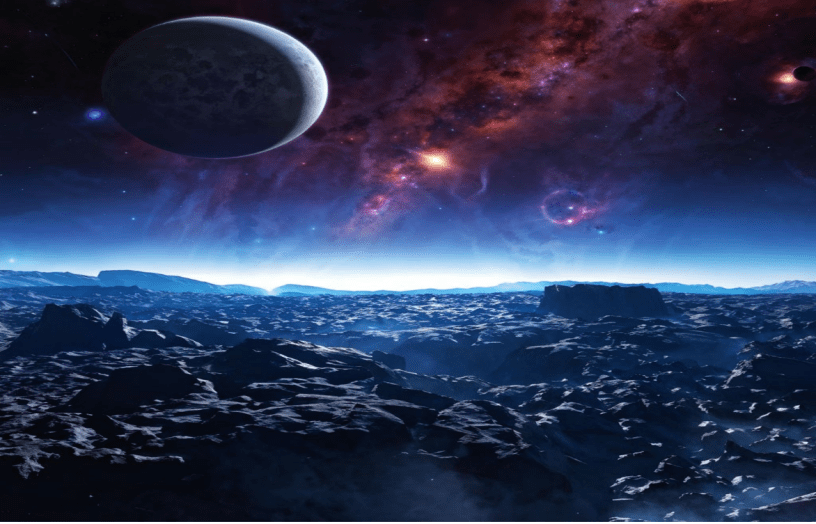
The eventual cold, dark state of the universe, often referred to as “heat death” or the “Big Freeze,” is the ultimate fate predicted by the Second Law of Thermodynamics. As the universe continues to expand, the finite amount of usable energy will gradually dissipate, leading to a state of maximum entropy where all energy is evenly distributed, and no thermodynamic work can occur. In this distant future, stars will have exhausted their nuclear fuel and burnt out, galaxies will drift apart, and black holes will slowly evaporate through Hawking radiation. The cosmos will become an expanse of cold, dark emptiness, devoid of any life or activity, marking the end of all physical processes. This stark reality underscores the necessity of an eternal, sustaining force outside of the natural order—God, who transcends time and space and offers eternal life beyond the temporal confines of the universe.
The Second Law of Thermodynamics and Its Implications
The Second Law of Thermodynamics is a foundational principle in physics, describing the natural tendency of energy to disperse and systems to progress toward disorder. It implies that:
- Energy Dissipation: Energy transitions from
usable (low entropy) to unusable (high
entropy) forms. - Finite Universe: The finite amount of usable
energy suggests the universe has a beginning
and will have an end.
This scientific principle resonates with the biblical assertion of a finite, created universe. Genesis 1:1 states, “In the beginning, God created the heavens and the earth.” The universe, therefore, is not self-sustaining; it requires an external source of energy and order—God.
God: The Creator and Sustainer
God, as revealed in the Bible, is described as the eternal “I AM” (Exodus 3:14), highlighting His self existence and self-sufficiency. Unlike the universe, God is infinite and unchanging. He is the source of all energy, life, and order. God is the “To Be” that counteracts “Not to Be”.
● Creator: “In the beginning, God created the heavens and the earth” (Genesis 1:1).
● Sustainer: “He is before all things, and in Him, all things hold together” (Colossians1:17).
God’s nature is further elucidated in John 1:3-4: “All things were made through Him, and without Him was
not anything made that was made. In Him was life, and the life was the light of men.” God’s creative power and sustaining presence are the bedrock of all existence.
God’s Eternity and Independence from Time
God’s self-identification as “I AM” signifies His existence outside of time and space. Unlike the created universe, which is bound by the dimensions of time and space, God is eternal and uncreated.
● Eternal Nature: “Before the mountains were brought forth, or ever you had formed the earth and the world, from everlasting to everlasting you are God” (Psalm 90:2).
● Uncreated Being: “For thus says the High and Lofty One who inhabits eternity, whose name is Holy: ‘I dwell in the high and holy place’“ (Isaiah 57:15).
Time is a measurement relevant only to the created order, a dimension that governs the cosmos. God, however, transcends this dimension, existing eternally and independently of time. His eternal nature underscores His role as the ultimate cause and sustainer of all that exists.
Sin: The Absence of God and Life
Sin is fundamentally a transgression of God’s law (1John 3:4) and results in a separation from God. The wages of sin, as stated in Romans 6:23, is death— both physical and spiritual.
● God is Light: “God is light, and in Him is no darkness at all” (1 John 1:5).
● God is Life: “I am the way, and the truth, and the life” (John 14:6).
Just as darkness is the absence of light, death is the absence of life. Sin, therefore, represents the absence of God’s presence and life in an individual. Once man chose good and evil the LORD cut them off from he
Tree of Life and sentenced them to death.
Gen 3:22 Then the LORD God said, “Behold, the man has become like one of us in knowing good and evil. Now, lest he reach out his hand and take also of the tree of life and eat, and live forever—”
Death: The Natural Consequence of Sin
When God’s law is violated, life ceases to function as intended. The absence of God’s sustaining force leads to death. This is not merely a punitive measure but a natural causal result. James 1:15 succinctly explains, “Then desire when it has conceived gives birth to sin, and sin when it is fully grown brings forth death.”
● Jesus as the Light: “Again Jesus spoke to them, saying, ‘I am the light of the world. Whoever follows me will not walk in darkness, but will have the light of life’“ (John 8:12).
● Jesus as the Life: “I am the resurrection and the life. Whoever believes in me, though he die, yet shall he live” (John 11:25).
Through Christ, believers are reconciled to God, receiving not only forgiveness but also the indwelling
presence of God’s Spirit, which sustains them.
The Positive Motive Force: God as “To Be” God embodies the ultimate “To Be,” the positive force that opposes the “Not to Be” of sin and death. His nature as the sustainer of life is crucial for understanding the gravity of sin and the transformative power of His grace.
● God’s Creative Power: “By the word of the Lord the heavens were made, and by the
breath of His mouth all their host” (Psalm 33:6)
● God’s Sustaining Power: “And He is before all things, and in Him all things hold together” (Colossians 1:17).
Scientific Corroboration and Theological Harmony
The interplay between the Second Law of Thermodynamics and the biblical narrative provides a coherent understanding of the universe’s finite nature and humanity’s dependence on God. The increasing entropy aligns with the biblical perspective of a created, finite universe awaiting renewal.
● Finite Universe: Scientific evidence supports a universe with a definite beginning (the Big Bang) and an eventual end (heat death), aligning with the biblical account of creation and final redemption.
● Dependence on God: The universe’s reliance on an external sustaining force parallels humanity’s spiritual dependence on God for life and sustenance.
In conclusion, the Second Law of Thermodynamics underscores the finite nature of the universe, pointing to the necessity of an infinite creator—God. The biblical depiction of God as the “I AM” affirms His eternal, self-sustaining nature, contrasting starkly with the entropy and mortality inherent in creation.
Sin, defined as the transgression of God’s law, results in death—the absence of God and life. However, through Jesus Christ, God offers the gift of eternal life, restoring the relationship and life lost through
sin. This profound theological truth underscores God’s role as the ultimate “To Be,” the positive motive force of the universe, opposing the “not to be” of sin and death.
As believers, recognizing God’s sustaining power and the consequences of sin deepens our understanding of His grace and our dependence on Him. The harmony between scientific principles and theological truths provides a robust framework for understanding our existence and the hope we have in Christ.
God’s eternal existence outside of time, His uncreated nature, and His role as the sustainer of the cosmos
highlight the profound depth of His sovereignty and love. This understanding encourages believers to live
in the light of His presence, avoiding the darkness of sin, and embracing the eternal life offered through
Jesus Christ.
 The Herald of Truth