
Have you ever thought about the comparisons between the Feasts that God gave His people in Leviticus 23 and the Christianized pagan holidays that most of Christendom has adopted in place of God’s Feasts? For instance, Passover focuses on the death of Jesus on the cross which takes away the sins of the world, and the Days of Unleavened Bread teaches us the need to rid our lives of sin. But – Easter (some call it Resurrection Day, which is more Biblical) has replaced the Passover and Days of Unleavened Bread. Yes, the resurrection of Jesus is usually acknowledged, but many times the main focus is on the Easter bunny and finding the eggs that it has left for the children to find.
The Feast of Tabernacles, celebrated in September or October each year, was the time when Jesus was actually born in human form. It was when He came to Tabernacle among men. And it has great prophetic meaning. But Christmas, on December 25, is now celebrated as His birth – and the celebration is nothing like His birth as described in the Bible. Now there are glittering lights everywhere, catchy Christmas carols playing constantly, presents galore, a jolly Santa Claus who knows everything you have done all year long, parties, drinking, decorated trees, etc. Where is any of that in the Bible? Where is Jesus in any of that?
But we can find much of those traditions in the pagan holiday is was derived from. I have come to this conclusion: the keeping of the Feasts of God feeds the inner man and draws him into closer fellowship with our Creator, the One who ordained these Feasts. They focus the mind on that full salvation plan and redemption that God ordained from the beginning of the world, and keeps one watching for the return of the Messiah through the meaning of these Feasts. The holidays the Christian church now keeps in place of God’s festivals feed only the flesh and little else.
In reality, God’s Feasts show us His plan of redemption and restoration through the order in which each Feast comes each year. They give us a “Kingdom” mind, rather than a worldly focus. And in the center of each Feast, we find Jesus. He is our Passover Lamb Who takes away the sin of the world: He is our redeemer from sin; He is the Living Word written in our hearts; He is the coming Messiah and King of peace; He is the Judge; He is the Prince of
Peace; He is the Bridegroom; He is Giver of Living Water, and so much more.
We go to Leviticus 23 to find all of God’s Holy Days listed, along with when they should be kept and of what they are a shadow. But in reality, they began in Genesis 1:14 with the word “seasons” which in the Hebrew means festival, appointed time, assembly, feast. Interesting, isn’t it? Also very interesting is the fact that the word “Feasts” in Leviticus 23:2 is the same Hebrew root word – same meaning exactly. The first Feast listed in Leviticus 23 is the weekly 7th day Sabbath. You may have never thought of it as a Feast, but there it is declared to be so – a holy convocation each week unto the Lord. We can trace the beginning of the Sabbath as a holy day back to the week of creation – it was the 7th day of creation. Who can
change the days or order of the creation in Genesis 1 and 2? It can’t be done. The first day of the week, which some now claim to be the day God set apart for rest, can never be exchanged for the seventh day. It is not in the power of man to be able to change any of it.
God, in His infinite wisdom, set all things in motion and order by His Word and who can change God’s Word? No one. The Sabbath is not only a day that looks back to creation, for God declared that He had ended His works and rested from them on that day, but it looks forward as a prophetic day to the Kindgom of Jesus Christ when He rules and reigns on
earth, and peace and rest cover the land. (You see, the coming Kingdom of Jesus Christ was finished in that week of creation also – God did it all in 6 days and ended His work. And it was all done by the spoken Word.)
A quick overview of the other Feasts are: Passover – representing the blood of Jesus
covering the doorposts of our hearts and leading us out of sin. Unleavened Bread for seven days – represents putting sin out of our lives. (First fruits is included in that week, representing the resurrection of Jesus from the dead.)
Pentecost comes next – 50 days after Passover. It is believed that Moses received the Law from God on Mt. Sinai on the Day of Pentecost. How does that compare to the Pentecost in Acts 2? I believe that the infilling of the Holy Spirit quickens the Word of God written on our hearts and makes it a living Word of God, filling us with life and power (the New Covenant, Heb. 8:10). It was no more just a spoken Word, as in the beginning. It was no longer written on tables of stone, but now it is written on the heart of those who have covenanted with God and sealed it with the shed blood of Jesus Christ. It has superseded
human nature and gives us a spiritual nature. We are still in the era of Pentecost when the Church was commissioned to “Go into all the world and preach the Gospel.” But that time is growing short. Jesus said to “work, for the night is coming.”
Next comes the Day of Trumpets – and an announcement being made. Announcement of what? The coming of Jesus. Paul states that when the last trump sounds, the dead in Christ will be raised and those living will caught up in the air by the angels, to meet the coming Messiah in the clouds (see I Corinthians 15:52; I Thessalonian 4:15-18). The last trump to sound is in Revelation 11 and declares that the kingdoms of this world are become the kingdoms of our Lord, and of His Christ; and He shall reign for ever and ever.
Next is the Day of Atonement. Because the word atonement denotes blood shed for sins, some think this is a repeat of the Passover. Jesus did atone for our sins on Passover, but this day looks to something different. In the pattern of God’s plan for a restored world, the next thing to happen after Christ sets up His kingdom would be the Judgment. In the Old Testament, on the Day of Atonement, the high priest made atonement for his own sins, then the sins of his family, and last for the sins of the nation. It is a solemn feast day. In Matthew 24 Jesus gives us the signs that lead up to His second coming. And in the very next chapter, He gives us parables of what it will be like when He comes – some will be ready and watching, while others will miss the entrance into His Kingdom.
In Matthew 25:32 to the end of the chapter, it tells of the judgment of the nations. I connect this back to the Old Testament when the high priest made atonement for the nation. In Matthew 25:31, Jesus sits on His throne and all nations are gathered before Him
to be judged. This can perhaps be compared to a physical harvest when the “wheat and the tares” are separated. Those who have repented and have their sins atoned for will be separated from those who have not.
Next is the Day of Atonement. Because the word atonement denotes blood shed for sins, some think this is a repeat of the Passover. Jesus did atone for our sins on Passover, but this day looks to something different. In the pattern of God’s plan for a restored world, the next thing to happen after Christ sets up His kingdom would be the Judgment. In the Old Testament, on the Day of Atonement, the high priest made atonement for his own sins, then the sins of his family, and last for the sins of the nation. It is a solemn feast day. In Matthew 24 Jesus gives us the signs that lead up to His second coming. And in the very next chapter, He gives us parables of what it will be like when He comes – some will be ready and watching, while others will miss the entrance into His Kingdom. In Matthew 25:32 to the end of the chapter, it tells of the judgment of the nations. I connect this back to the Old Testament when the high priest made atonement for the nation. In Matthew 25:31, Jesus sits on His throne and all nations are gathered before Him to be judged. This can perhaps be compared to a physical harvest when the “wheat and the tares” are separated. Those who have repented and have their sins atoned for will be separated from those who have not.
Next comes the feast of rejoicing, which is the Feast of Tabernacles and focuses our spiritual sighton the earthly reign of Jesus Christ when peace prevails over the whole earth. Zechariah 14:16-18, among other scriptures, tells us that during Christ’s earthly reign, all nations will go up to worship in Jerusalem during the Feast of Tabernacles. If they
don’t, then they will have drought in their nation. This is certainly not a feast that should by any means be ignored. This Feast is symbolic of the harvest being over and the workers rejoicing in the fruit of their labors.
And attached to the end of the Feast of Tabernacles is the Last Great Day of the Feast, that
day when Jesus cried out “If any man thirst, let him come unto Me and drink” (John 7:37). What this Last Great Day pictures in God’s yearly Feasts is detailed out for us in the last few chapters of Revelation.
In chapter 19 the saints are called to the Marriage Supper of the Lamb; in chapter 20 our last enemy, which is death, is destroyed; and in chapters 21 and
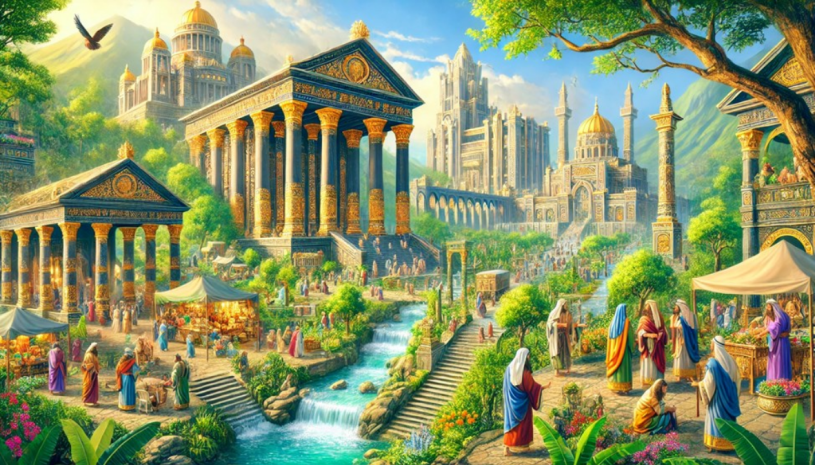
22 the dwelling place that Jesus went to prepare for us (John 14:2) comes down from God out of heaven. Eternity has begun! I so love reading chapters 21 and 22 of Revelation. There is so much richness in it, so many joyous promises, and total restoration back to
God’s original plan for mankind. There is no more death, no more sorrow, no more crying, no more pain. What joy! No more funerals to go to, no more wheelchairs or crutches, no more need for hospitals, etc. Jesus will be there and will light the whole city – the New Jerusalem.
If you compare Revelation 21 and 22 with Genesis, chapters 1 and 2, you will find
many similarities between the two Referring back to Jesus’ words in John 7:37, we find that this living water He speaks of flows from the throne of God and out of the Lamb. I also see that this New Jerusalem is not made up of only New Testament people. It is a mixture of the Old and New Testaments. It’s foundation is on the 12 Apostles and the redeeming
Gospel of Jesus Christ, the power of His blood to save and redeem. But to enter the City, one has to go through a gate that has the name of one of the Tribes of Israel over it. In other words, the law and the prophets are part of the building of this City as well as the Apostles and their ministry to the Gentiles. Note that as the Garden of Eden had the Tree of Life, so it is in the New Jerusalem, producing 12 kinds of fruit. Do you notice a pattern here – 12 foundations, 12 gates, 12 fruits? The City is four square, meaning it is equal in height, depth, and width on each of the four sides. In 28:15-20 the Priest’s breastplate was foursquare and had 12 stones, 3 on each side. The foundations of this new city are garnished with 12 different precious stones. And this brings me to the final Scripture that I will use – Malachi 3:17, “And they shall be mine, saith the Lord of hosts, in that day when I make up my jewels; and I will spare them, as a man spares his own son that serves him.”
Do you see how God has a plan and He gives usdays off from the toil of this life so that we can focus and look ahead to His beautiful plan to restore all things? He lets us get together, to mull over these precious times that are coming, to encourage one another to keep our focus on Jesus and be watching for our King’s return. How wonderful of our Father
God to share such insights with us through His Feasts. What precious times of refreshing that come from these festivals – from God Himself.
 The Herald of Truth