
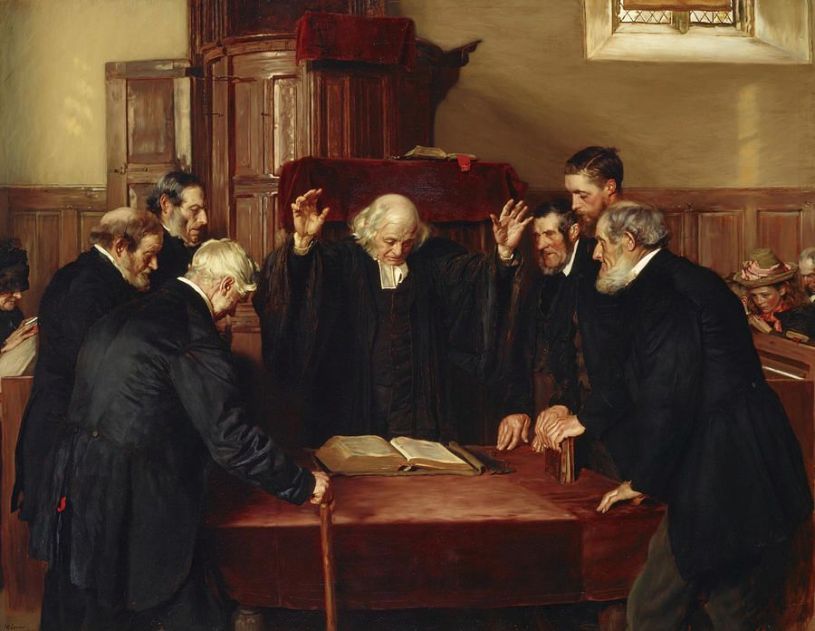
Years ago, while in my twenties, I moved to Southern California and began attending a congregation in La Crescenta. After learning that I had recently graduated from seminary, the leadership quickly put me to work serving the congregation through ministry and public speaking. One thing becomes apparent very quickly when serving in a leadership role within a church: people begin bringing you their problems. You counsel them, encourage them, and offer biblical guidance where you can. Yet sometimes their problems are not merely spiritual or emotional—they are real, practical situations requiring immediate action and accountability.
One of those problems quickly revealed itself in the form of sexual misconduct within the congregation. There was a married man in his seventies who was preying upon young girls in the church. I discovered that he had attempted to rape one girl and groped another, and nothing had been done. I went immediately to the pastor, who dismissed it — the man was his close friend. I then brought the matter to the elders. They also did nothing, deferring to the pastor’s characterization of the accusations as false. When I confronted the man himself, he denied everything. Even though I continued to be an advocate, the young woman — like the others — stopped attending, and I was stripped of my leadership duties.
But the predator did not stop. He simply found a new target. I warned that girl’s parents, and they kept her away. Undeterred, he then befriended a widow in the congregation who had a fourteen-year-old daughter. I warned the widow repeatedly, but he had already convinced her that my accusations were false. I brought the matter to the elders again, arguing that it was plainly inappropriate for a man in his seventies to monopolize the time of a teenage girl at church functions. Still, the elders deferred to the pastor and did nothing. After several months of grooming both mother and daughter, the widow allowed him to babysit her child. He immediately attempted to rape her. It was only when the police became involved that the church leadership was finally compelled to act.
Which raises a question that deserves a serious answer: how could the elders of a church watch a man with multiple accusations of sexual misconduct- openly groom a fourteen-year-old girl — in plain sight — and do nothing? Church government.
The organization had repeatedly taught the importance of a strict hierarchical form of church government, insisting that opposing the chain of command was equivalent to the “rebellion of witchcraft.” Every ordination was treated as though it came directly from God Himself, and to question leadership decisions was considered a grave sin. All reality had to be filtered through that paradigm. Facts were no longer established by two or three witnesses, but by the opinion of the pastor. The result was that elders ignored the reality unfolding before their own eyes.
But does Scripture truly support such a rigid top-down hierarchy similar to that of the Roman Catholic Church? Are elders required to blindly obey a pastor’s marching orders like soldiers under a commanding officer? On the other hand, is a purely congregational system biblical, where members may remove a pastor by majority vote at any moment? Or should churches function with virtually no leadership at all?
Despite the many models of church government that exist today, Scripture is clear that leadership within the congregation does exist and carries real authority.
“Let the elders who rule well be considered worthy of double honor…”
— 1 Timothy 5:17
“Obey your leaders and submit to them, for they are keeping watch over your souls…”
— Hebrews 13:17
It is evident that congregational leadership possesses authority, including the responsibility to remove those who refuse to live as Christians. In 1 Corinthians 5, Paul specifically instructed the congregation to remove an openly sinful man from their fellowship. Leadership and authority within the Church are biblical realities.
This is why Paul instructed Titus to:
“appoint elders in every town as I directed you.”
— Titus 1:5
Yet when we examine the New Testament as a whole, a remarkably consistent pattern emerges. The terms “elder” (presbyteros) and “elders” are repeatedly connected with local church government, ordination, discipline, shepherding, prayer, and oversight. Elders are appointed in every church (Acts 14:23; Titus 1:5). Elders shepherd the flock (1 Peter 5:1–3). Elders pray over the sick (James 5:14). Paul summoned the Ephesian elders to instruct them concerning church oversight (Acts 20:17–28). Accusations against elders were to be handled carefully and established by witnesses (1 Timothy 5:19). The evidence for elders functioning as the ordinary leadership structure of local congregations is overwhelming.
When we step back and examine the New Testament statistically, the pattern becomes even more striking. The words “elder” and “elders” appear more than sixty times throughout the New Testament and consistently appear in contexts involving church leadership and oversight. By contrast, the term “pastor” appears only once in most modern English translations in Ephesians 4:11, while “evangelist” appears only three times. Even more importantly, Scripture never explicitly records anyone being ordained into a separate office called “pastor,” nor does it describe local congregations being governed by a singular pastor ruling independently above a body of elders. The cumulative weight of this repeated biblical pattern should not be ignored.
And when we begin examining some of the other supposed offices found within modern church hierarchies, the argument for rigid rank structures becomes even weaker.
Many Christians assume the title “apostle” referred only to the Twelve plus Paul. Yet Scripture itself uses the term more broadly. Acts 14:14 refers to:
“the apostles Barnabas and Paul…”
Barnabas is explicitly called an apostle.
Likewise, in 1 Thessalonians, Paul, Silvanus, and Timothy are included together in the opening greeting, and later Paul refers to “we” as “apostles of Christ” (1 Thessalonians 2:6), which many scholars understand as including all three men. Even Epaphroditus is called an apostolos—literally “messenger” or “sent one”—in Philippians 2:25.
In 2 John and 3 John, John introduces himself simply as:
“The elder…”
That is difficult to overlook. If any man in the New Testament had grounds to emphasize rank or office, it would have been John. He was an apostle, an eyewitness of Christ, and likely the final surviving member of the Twelve. Yet he identifies himself simply as an elder.
The elders in La Crescenta became so convinced that questioning the pastor was equivalent to rebellion that they permitted open sin to continue within the congregation. Yet throughout Scripture we repeatedly find church leaders openly discussing, disagreeing, and reasoning together without anyone being excommunicated merely for disagreement.
Consider the dispute between Paul and Barnabas regarding John Mark:
“And there arose a sharp disagreement, so that they separated from each other.”
— Acts 15:39
Because of this sharp disagreement, Paul and Barnabas went separate ways in ministry. Yet we do not see either man “pulling rank” or attempting to excommunicate the other. They simply separated peacefully and later reconciled.
Likewise, Paul publicly rebuked Peter:
“I opposed him to his face…”
— Galatians 2:11
That is difficult to reconcile with later authoritarian concepts of unquestionable office. Truth—not rank—remained supreme.
The disagreement between Paul and Apollos makes the pattern even clearer:
“And concerning our brother Apollos, I strongly urged him to come to you with the brothers, but he had no desire at all to come at this time…”
— 1 Corinthians 16:12
The tone of Paul in this letter is apparent he was not happy to say the least. Even though he strongly urged Apollos to visit Corinth, Apollos refused and chose to come later at a more convenient time. Yet again, no one pulled rank. No one was expelled. The concept of an unquestionable top-down hierarchy begins to collapse under the actual examples found in Scripture.
Notice also Peter’s words to the elders:
“The elders who are among you I exhort, even as a fellow elder…”
— 1 Peter 5:1
Peter does not appeal to rank or title. He identifies himself simply as a fellow elder and eyewitness of Christ’s sufferings. He then instructs the elders:
“Feed the flock of God that is among you… not as exercising lordship over those entrusted to you, but by being examples to the flock.”
— 1 Peter 5:2–3
The emphasis is not upon domination, coercion, or hierarchical control, but upon example, service, and shepherding. The idea of authoritarian hierarchy is notably absent from Peter’s instructions.
One of the primary passages often used to justify rigid church hierarchies is Ephesians 4:11:
“And he gave the apostles, the prophets, the evangelists, the shepherds and teachers…”
Yet when examined carefully, the passage does not explicitly describe ranks of authority or a chain of command. Rather, the context strongly suggests functions, gifts, and ministries given by Christ to serve the Body. The very next verse explains their purpose:
“to equip the saints for the work of ministry, for building up the body of Christ.”
— Ephesians 4:12
The reason for these duties is for equipping, edifying, teaching, shepherding, and serving—not governmental structure and organization.
Even the Greek terms themselves support this understanding. “Apostle” literally means “one sent.” “Evangelist” refers to a proclaimer of good news. “Pastor” is simply the Greek word for “shepherd.” “Teacher” describes one who instructs. These words primarily describe functions and responsibilities rather than military-style ranks within a hierarchy.
Imagine if I was running a restaurant. I would need waiters, cooks, dishwashers, table bussers and a hostess. None of these duties implies rank or authority.
Nothing in Ephesians 4 states that apostles rule over prophets, prophets over evangelists, or pastors over elders. Such assumptions are often imported into the text from later institutional traditions rather than drawn naturally from the passage itself.
This becomes even more significant when Ephesians 4 is compared with the repeated operational pattern found throughout the New Testament. While Ephesians 4 briefly lists ministry functions, the actual governmental structure repeatedly described in Acts and the Epistles centers upon elders. Elders are appointed in every church. Elders shepherd the flock. Elders oversee doctrine and discipline. Elders pray over and anoint the sick. By contrast, Scripture never explicitly records the ordination of a singular pastor ruling independently above a body of elders. It is unmistakable, by the cumulative weight of biblical evidence that Ephesians 4:11 is describing the duties and responsibilities within the Body of Christ not rank or position. Scripture repeatedly shows eldership as the structure of local church oversight under Christ, the true Head of the Church.
Shortly after the sexual predator was finally charged by police with sexual assault, the pastor removed him from the congregation. But for damage control he also had me excommunicated. Soon afterward, the once vibrant congregation of more than 300 members dwindled to fewer than 40 within a matter of months. The church fell apart because the congregation realized the leadership—including the elders—would not protect them.
As Christians, we are instructed to submit to one another, to live peaceably with all men, and to respect those placed over us in the Lord. Ultimately, all of us will answer before God. But if elders—who are specifically charged with shepherding, protecting, and ministering to the flock—allow the congregation to be scattered and devoured by wolves while excusing themselves with the words, “I was just following orders,” that excuse will not stand before God. Throughout history, terrible evils have been justified under that same excuse. And when elders refuse to question wrongdoing because they have elevated hierarchical church government above truth and righteousness, the government itself becomes their religion.
 The Herald of Truth