
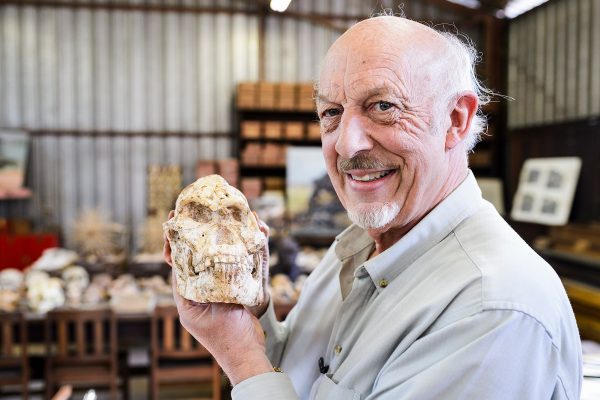
In 1994, Professor Ronald J. Clarke made what many hailed as one of the most significant discoveries in support of evolutionary theory: “Little Foot,” an Australopithecus hominin allegedly dating back approximately three million years. Little Foot is promoted as one of the most complete “early human” skeletons ever discovered. Unlike most hominid reconstructions that are assembled from only a handful of bone fragments, Clarke’s specimen was reportedly nearly 90% complete.
News outlets around the world celebrated the discovery as a monumental confirmation of evolution, and academia offered virtually no criticism of the fossil’s importance.
“Scientists have unveiled the skeleton of an ancient human ancestor… hailed as a ‘missing link’ that could rewrite our evolutionary history.” — The Independent
“This fossil remains one of the most important discoveries in the hominin record and its true identity is key to understanding our evolutionary past,” — IFLScience
Although there is supposedly “fierce debate” among paleontologists regarding the classification of the fossil, there is essentially no debate within consensus science over whether Little Foot is evidence of evolution. The science, we are told, is settled.
However, much like many “safe and effective” drugs approved by the FDA, a closer examination raises some uncomfortable questions.
The first major issue is how this “landmark discovery” was actually found.
The bones attributed to Little Foot were recovered from the caverns of Silberberg Grotto in South Africa, an area that had also been used as a limestone mine since the 1940s. During that period, dynamite blasting was the preferred method of excavation. As miners encountered bones from various animals, they tossed them into boxes and eventually donated them to the university.
Years of blasting later, Ron Clarke examined these accumulated boxes and reportedly discovered the remains of a primate foot.
He then returned to the caverns to search for the remainder of the skeleton. By allegedly matching the contours of rock formations within the cave, he concluded he had identified the original blast location. With the help of students, he began excavating and eventually assembled what was presented as a nearly complete prehistoric hominin skeleton.
Yet somehow, despite being a professor at the University of the Witwatersrand, Clarke appears to have bypassed nearly every principle of careful archaeological and paleontological excavation — the very same principles often weaponized against Christian archaeologists and researchers.
Those principles normally include:
- Obtaining proper excavation permits from local authorities.
- Systematically gridding and documenting the site with photographs throughout the process. In archaeology, depth and stratification are just as important as location.
- Submitting finds for laboratory analysis as excavation progresses. Artifacts are typically cataloged, documented, and analyzed immediately upon removal.
- Maintaining a secure chain of custody and independent oversight to ensure the artifacts recovered are the same artifacts later presented to the public.
- Publishing detailed chronological documentation for peer review.
Curiously, when discoveries are said to support evolutionary theory and atheistic assumptions, these “sacred rules” suddenly seem far more flexible.
During Clarke’s excavation, there was no verifiable chain of custody proving that any of the recovered bones actually originated from the location claimed. There was no independent third-party verification confirming the original source of the bones. There was no DNA or organic testing demonstrating that the recovered bones all belonged to the same creature.
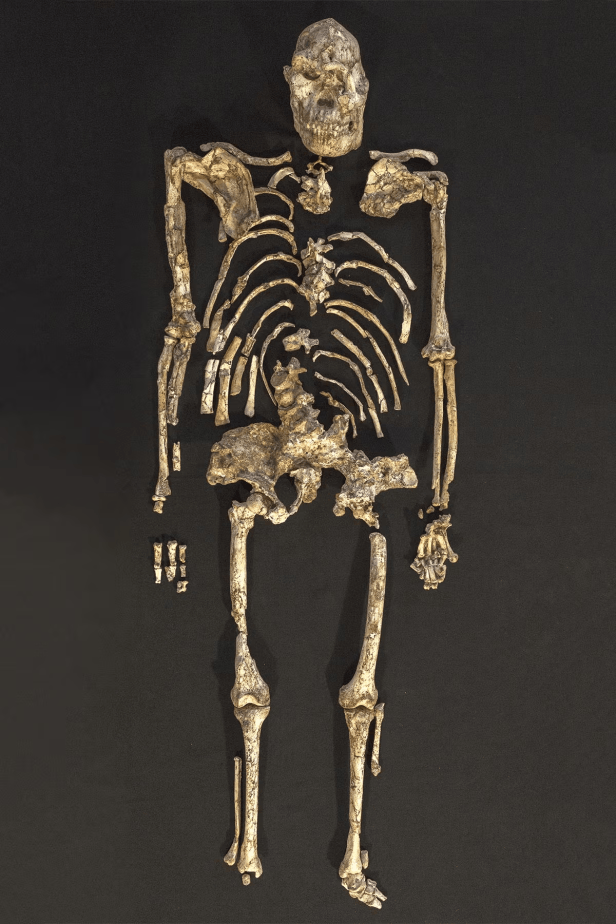
Instead, the primary method used to assemble the skeleton was what Clarke described as “break matching” — essentially matching fractures and contours in the rock and bones wherever the team believed connections existed.
The problem is that many parts of the reconstructed skeleton show no direct connection to one another at all. There is no intact connection between the spine and pelvis, nor between the spine and shoulders. The ribs exist independently. If “break matching” was the determining method, how exactly do you match bones that were never connected by breaks in the first place?
At some point, the credibility of the reconstruction begins to resemble the standard action-movie line:
“Trust me. I know what I’m doing.”
Another glaring observation is the skull itself.
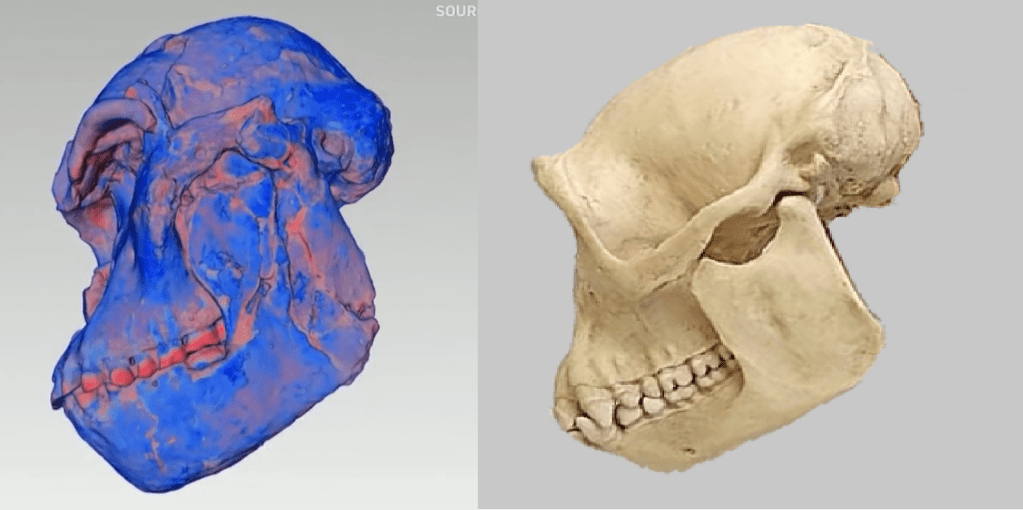
The skull of Little Foot bears a striking resemblance to that of a pygmy chimpanzee. Not only do the two skulls appear remarkably similar visually, but they are also nearly identical in size. Adult female pygmy chimpanzees possess a cranial capacity of approximately 400–420 cc. Little Foot measures roughly 408 cc.
It is also important to remember that all primates — including humans — exhibit natural biological variation within a species. This can be as high as 10%. Environmental factors such as nutrition, labor, injuries, disease, and living conditions could produce a 30% variation. Anyone who has spent enough time “people watching” in an airport already understands this intuitively.
This matters because many evolutionary arguments surrounding Little Foot rely on extremely subtle changes in angles, bone shapes, and proportions, often treating those tiny differences as though natural variation could not possibly account for them.
Ironically, many of the same scientists who insist the earth has undergone massive geological upheaval to explain marine fossils on mountaintops or sedimentary formations resembling mudflows will simultaneously insist that this skull experienced virtually no meaningful deformation while allegedly embedded in limestone for three million years.
Another critical question is how Little Foot was dated.
Researchers relied primarily on radiometric dating of the surrounding limestone using aluminum-beryllium methods. However, there is an important distinction between Carbon-14 dating and all other radiometric dating systems.
Carbon-14 dating from its inception was formulated using historically verifiable materials. Scientists were able to compare the method against known-age samples such as ancient wood, Egyptian artifacts, petroleum products, and other historically datable organic material.
Most other radiometric dating systems possess no such benchmark.
There is no historically verified artifact that is one million years old. There is no recorded human history stretching back three million years. In fact, there are no independently verified historical records extending even remotely close to those timescales.
In multiple documented cases, recently formed lava rock from locations such as Mount St. Helens, Mount Ngauruhoe, Mount Etna, and volcanic flows in Hawaii have produced wildly inflated radiometric dates ranging from hundreds of thousands to millions of years old.
So outside of Carbon-14, we once again arrive at the familiar phrase:
“Trust me. I know what I’m doing.”
Once Clarke and his team assigned Little Foot an age of three million years through unverified radiometric assumptions, the conclusion became almost automatic. Since pygmy chimpanzees could not exist at that time according to evolution, the fossil must be a pre-human ancestor.
Isn’t science amazing?
To this day, scientists have uncovered millions of fossils from creatures they claim are vastly older than early man: trilobites, ammonites, bivalves, and countless other extinct species supposedly dating back hundreds of millions of years. Even dinosaurs from the Jurassic Period — creatures alleged to have lived tens of millions of years ago — are represented by hundreds of skeletons and thousands upon thousands of fossil remains.
Yet when it comes to “early man,” the fossil record suddenly becomes remarkably thin.
Little Foot is celebrated precisely because it is considered one of the most complete specimens ever found. Think about that for a moment. After more than a century of excavation, global funding, university expeditions, documentaries, museums (Smithsonian), and nonstop media hype, one of the best examples of “early man” is still a chimp skeleton reconstructed from blasted cave debris in a South African limestone mine.
For a theory presented to the public as unquestionable fact, the actual physical evidence is more like a joke.
Consensus science may tell us that God is dead, morality is relative, and the Bible is little more than mythology and folklore. Yet Scripture warns us plainly not to place ultimate trust in the claims of men.
“Thus says the LORD: ‘Cursed is the man who trusts in man and makes flesh his strength, whose heart turns away from the LORD.’”
Jeremiah 17:5–7 (ESV)
When societies place blind faith in the authority of man rather than God, there is a real consequence. Our universities and elite institutions — the very centers proclaiming enlightenment and progress — have increasingly become epicenters of immorality, confusion, corruption, and hedonism.
As Christ Himself said, “You will know them by their fruits.”
And the fruit produced by much of modern consensus “science” has been rebellion against God, contempt for truth, and moral decay.
Trust no man. Micah 7:5

