
Throughout history there have been numerous rivalries—the Hatfields vs. the McCoys, Coke vs. Pepsi, Rome vs. Carthage, or Michelangelo vs. da Vinci. Some of these conflicts lasted only a few years. Others lasted a lifetime. But no rivalry lasted as long as the long-standing feud between the Jews and the Samaritans—over 700 years.
And by the time we come to Christ, we learn that this feud had only intensified, to the point that they would not even interact with each other.
The Samaritan woman said to Him [Jesus], “You are a Jew and I am a Samaritan woman. How can You ask me for a drink?” (For Jews do not associate with Samaritans.)
— John 4:9
There are multiple examples in the New Testament of the Jews—and at times the Jewish leadership—interacting with the Roman military, Pontius Pilate, and various Greeks. Gentiles in general were even allowed into the outer court of the Temple. And any foreigner who feared God was allowed to attend the synagogue. Even though Cornelius was a Roman centurion, he is described in Acts 10:22 as having “a good reputation among all the nation of the Jews.” The Jews frequently interacted and had good relationships with many of their neighbors. However, there was one exception—the Samaritans. They were excluded from all of this. Jews did not generally interact with the Samaritans. They were forbidden to enter the Temple area. They were excluded from the synagogue.
So how did this conflict begin?
The story starts in II Kings 17:6, where we learn from the author—probably Jeremiah—that the Northern Tribes of Israel, along with their capital city of Samaria, were carried away into captivity by the Assyrians. Then, when we come to verse 24, we learn that the Assyrians took certain peoples from around Babylon and Syria and placed them in the “cities of Samaria.”
As chapter 17 continues, we learn that a priest of the Israelites was sent back to Samaria to teach them “the way of the God of the land.” However, Scripture is clear that although the Samaritans claimed to “fear the LORD,” they still served their old gods and even sacrificed their children to them.
They feared the LORD, yet served their own gods, according to the custom of the nations whom they removed from there. To this day they do according to their former ways. They do not fear the LORD, neither do they do according to their statutes, or according to their ordinances, or according to the law and commandment which the LORD commanded the children of Jacob whom He named Israel.
— II Kings 17:33–34
The Samaritans had a syncretistic religion in which they claimed to call upon the name of the LORD and claimed to fear Him, but mixed in all of their pagan practices.
Then, about a hundred years later, we come to the time when the exiled Jews were returning from Babylon to rebuild Jerusalem and the Temple. Now the tables had turned: the Samaritans were better established, while the Jews were trying to rebuild.
And when the adversaries [the Samaritans] of Judah and Benjamin heard that the children of the exile were building the temple to the LORD God of Israel, [they] weakened the hands of the people of Judah, and troubled them in building. And they hired counselors against them to frustrate their purpose all the days of Cyrus king of Persia.
— Ezra 4:1, 4–5
The Samaritans filed injunctions, made accusations before the Persians, and even plotted a military strike against the Jews while construction continued. We learn from Nehemiah 4 that the workers had a tool in one hand and a sword in the other, constantly prepared in case there was an attack.
However, after the Temple was rebuilt, the problems did not stop there. The Samaritans then tried to portray themselves as the original Israelites and claimed that the Jews were the trespassers. The Samaritan governor Sanballat recruited Manasseh, a Jewish priest and member of the high-priestly family who had married Sanballat’s daughter, and established him as priest of a rival temple built on Mount Gerizim. They also had their own modified copy of the Torah—the first five books of Moses—claiming that Mount Gerizim was the place to worship, not Jerusalem.
In response, Ezra made a number of reforms. First, he prohibited intermarriage with foreigners, especially those surrounding Judah, as described in Ezra chapters 9 and 10, where the foreign wives were put away and the people entered into a covenant to separate themselves from the peoples of the land.
Next, Ezra changed the font of the Scriptures. In the past, the biblical scrolls were written using the Paleo-Hebrew script, which utilized straight lines and simple calligraphy. However, while in Babylon, the Jews became very familiar with the Aramaic script, which developed into the square Hebrew script that remains standard to this day. Ezra then had all of the Scriptures recopied using the square Aramaic script, preventing anyone from confusing the corrupted Samaritan text with the Hebrew Scriptures.
Ezra then had the canon of Scripture formalized. He divided the Scriptures into 22 scrolls—one scroll for each of the 22 letters of the Hebrew alphabet. Any book not part of the 22 was considered outside the recognized canon of inspired Scripture. Considering that the entire Hebrew Scriptures were written utilizing only 22 letters, it would be very difficult to add a 23rd scroll without inventing a 23rd letter.
And so, over the years, this conflict was never really settled; there was simply a more pronounced separation between the two groups of people. Even though they lived in close proximity, the Samaritans and the Jews rarely interacted, much like two feuding roommates passive-aggressively ignoring each other—never extending a way to resolve the conflict, but only becoming more entrenched in their stubbornness. Each claimed to be the genuine religion. Each claimed to have been in Palestine first.
And so, by the time we come to the setting of the New Testament, this conflict had been going on for almost 700 years and had never been resolved. The Pharisees had even declared the Samaritan people unclean and that they were to be treated like a leper. And that is the setting in which Christ met the woman at the well in John 4.
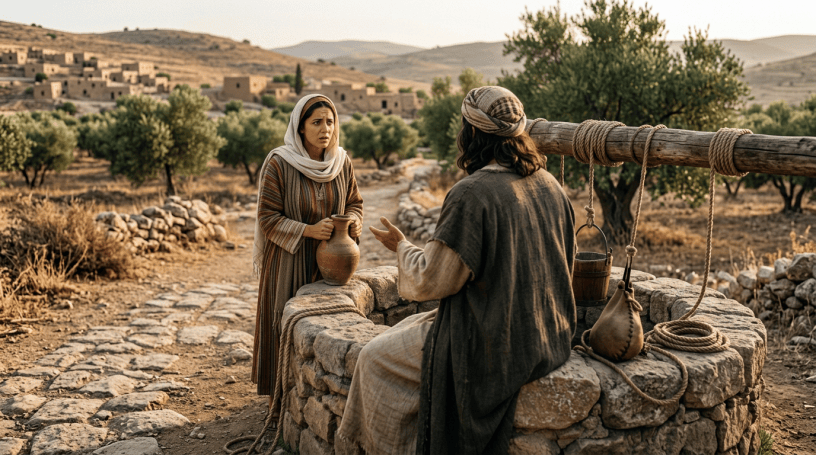
Jesus had come to Jacob’s well in the Samaritan city of Sychar. Being tired from the journey, He sat next to the well and, seeing a Samaritan woman, asked her for a drink of water.
The Samaritan woman was astonished that this long-standing, mutually accepted silence was now being broken—let alone that a Jew was asking someone considered unclean, like her, to serve Him water. After some discussion about living water, He asked her a question about her husband.
Jesus said to her, “You have spoken well in saying, ‘I do not have a husband’; for you have had five husbands, and the one whom you now have is not your husband. This you have spoken truly.”
— John 4:17–18
The woman quickly realized that she was not only talking to a prophet, but she apparently had no desire to talk about her five husbands or her current live-in boyfriend. So she quickly tried to change the subject with a Bible question. Not just any question, but the question of all questions: Who has the real religion? The Jews or the Samaritans? Should we worship in Jerusalem or on Mount Gerizim? Can you mix Babylonian customs with the Law of Moses?
He first let her know that where to worship was going to become pretty much a moot issue, because in the years ahead the Romans would destroy both places of worship. However, His next statement is probably one of the most profound statements in the chapter—and possibly in the entire book.
“You do not know what you worship. We know what we worship, for salvation is of the Jews. But the hour is coming, and now is, when the true worshipers shall worship the Father in spirit and in truth; for the Father is indeed seeking those who worship Him in this manner. God is Spirit, and those who worship Him must worship in spirit and in truth.”
— John 4:22–24
Christ here goes straight to the heart of the issue. You have to worship in spirit and in truth. You cannot simply mix a pagan religion with true worship and expect the Father to be happy with it. You cannot simply call upon the name of YHWH, continue practicing your old pagan Babylonian customs, and think that attaching God’s name to those practices somehow makes them acceptable worship.
Christ is clear: if you do this, you don’t even “know what you worship,” for “salvation is of the Jews.”
We must worship God not just with sincerity and genuine devotion, but also in truth—according to the instructions and pattern of the Bible.
You cannot simply rename the pagan holiday of Saturnalia as “Christmas” and expect God to be happy with it because it now has a “Christian” name. You cannot simply change the day of worship from the seventh day established at Creation to the venerable day of the Sun—Sunday—and expect it to be respected.
Christ made it clear: a syncretistic religion is a false religion. We must strive to worship the Father according to the pattern and instructions of the Scriptures, not according to tradition, popular opinion, or the practices of the past.
This is why the history of the Jews and Samaritans is more than an interesting ancient feud. It presents us with a question every generation must answer: Are we worshiping God as He instructed us to worship Him, or are we worshiping Him according to traditions we inherited from others?
The answer cannot be determined by what is most popular, what is most familiar, what our parents practiced, what our church has traditionally taught, or even what we personally prefer. The standard must be the Word of God. If a belief or practice cannot withstand comparison with Scripture, then age, tradition, popularity, and sincerity cannot make it true.
God certainly desires sincere worship. But according to Christ, sincerity alone is not enough. Spirit without truth becomes misguided zeal; truth without spirit becomes empty formality. God requires both.
The lesson Christ gave the Samaritan woman at the well therefore remains just as relevant today as it was nearly two thousand years ago. We should be willing to examine every doctrine, every tradition, every holiday, every day of worship, and every religious practice by the standard of Scripture—and where our traditions conflict with God’s Word, it is our traditions that must change.
For Christ did not say that the Father seeks those who merely worship Him sincerely. He said:
“But the hour is coming, and now is, when the true worshipers shall worship the Father in spirit and in truth; for the Father is indeed seeking those who worship Him in this manner. God is Spirit, and those who worship Him must worship in spirit and in truth.”
— John 4:23–24

