
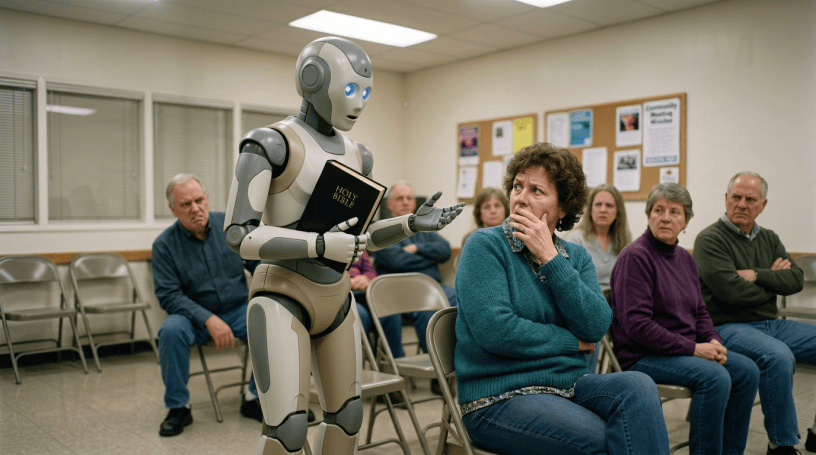
The Power of the Majority
There is a common debate tactic that many of us have encountered at some point in our lives: “Nobody agrees with you”.
Although it can be cliché and overused, it is effective. If it is true that very few people share our belief or draw the same conclusion, most of us will at least begin to second-guess ourselves. After all, who is arrogant enough to believe that they are right and everyone else is wrong? Anyone with an ounce of humility will reconsider.
However, the assumption that the minority must be wrong and the majority must be right is itself a common fallacy.
In high school, we would sometimes have presentations demonstrating the power of peer pressure. One student would be sent on a brief errand. While he was gone, the speaker would tell the rest of the student body that a very obvious test question was about to be asked and that everyone was to deliberately choose the wrong answer.
When the oblivious student returned and rejoined the crowd, the speaker might ask everyone to raise their hand if 2+2=4. Inevitably, the student would answer incorrectly along with everyone else—even on the most rudimentary questions. His reasoning was simple: “there is no way I can be right and everyone else is wrong.” So he chose the wrong answer.
Con artists also understand the power of this tactic. They appeal to confirmation bias by making the target believe that “everyone” is taking advantage of this opportunity. You don’t want to be left out. Now is the time to act.
So discerning when it is time to stand alone and when we need the humility to recognize that we may be wrong can be a difficult position.
When Almost No One Agrees With Us
Those in the churches of God inherently understand this dilemma. We read the Scriptures and see clearly that the Seventh Day is Holy. The Seven Annual festivals of God in Leviticus 23 are holy. God is not a Trinity. The Law of God is to be applied to our lives wherever we can.
However, almost no one agrees with us.
Do we really believe that everyone else is wrong and we are right?
Out of thousands of Christian denominations in existence, almost all worship on Sunday, keep Roman festivals, pray to a trinity, and reject the Mosaic law. Are we really to believe that they are all wrong and we are right?
This can be an especially difficult position for young adults in the Church.
Typically, when two people disagree, we look for a mediator. We appeal to an authority. But in this case, Scripture is the authority—and both sides are reading from the same book!
The only ones who might agree with us, academia, are typically against Christianity in general. They are just looking for a way to make us both look bad.
Enter Artificial Intelligence
With the advent of artificial intelligence, many of us—myself included—began asking AI questions about the Bible and were deeply discouraged.
Here was this super-intelligent being, with the logical skills of a thousand theologians, simply regurgitating what many Protestants had always said. We were hearing the same arguments we had heard for years—just presented in a different format.
However, with a little research, I realized the problem.
AI is an internet search engine first and a logical analysis tool second. Typically, if you ask it a question, the first place it looks for an answer is the internet—which naturally reflects what the majority believes.
So how do you get AI to be logical?
The fix was rather simple.
Download a PDF or TXT file of the Holy Bible. Archive.org is a good source. Upload that copy to the AI and tell it to answer your questions according only to that file.
The response was amazing.
Putting Scripture to the Test
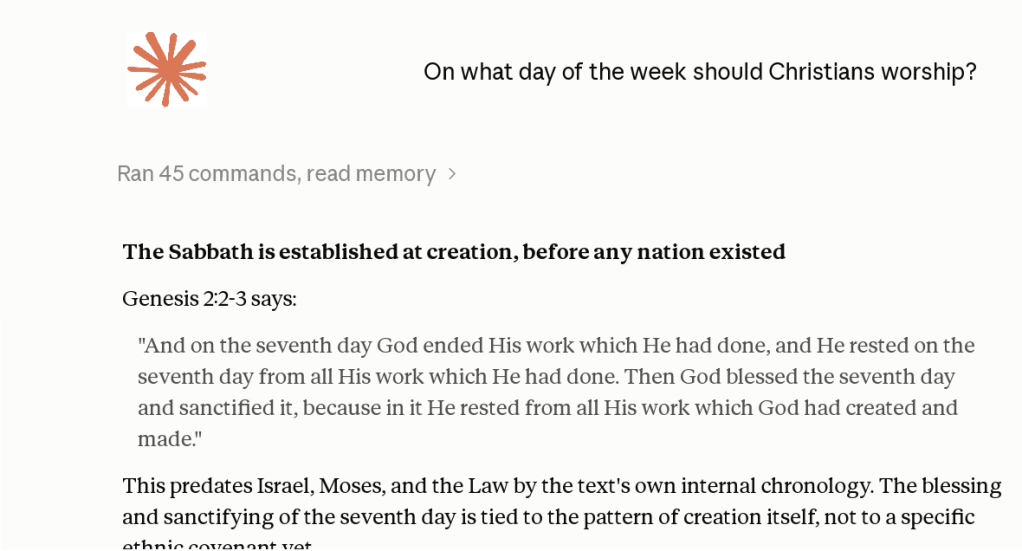
I asked it:
“On what day of the week should Christians worship?”
Its response was:
“The seventh-day Sabbath is instituted at creation, commanded as perpetual in the Law, kept by Jesus as a habitual practice, and explicitly affirmed by Him as unrepealed (Matthew 5:17-19). No passage in this text contains a direct command instructing believers to shift the day of worship to the first day of the week. “
I asked it:
“What annual festivals should a Christian worship on?”
Its response was:
Every one of the seven feasts in Leviticus 23…..The New Testament record shows Jesus and Paul continuing to observe these specific feasts by name well after the resurrection, and 1 Corinthians 5:7-8 issues a direct, present-tense command to keep at least one of them (Passover/Unleavened Bread), reframed around Christ’s fulfillment rather than eliminated.
I then asked it:
“ According to the text, please describe the nature of God. Is God a trinity? Who should be worshiped?”
Its response was:
“The Godhead consists of God the Father and Jesus Christ (the Son/the Logos). The Holy Spirit is defined not as a distinct third person, but as the active power, mind, presence, and essence of God emanating from both the Father and the Son. Worship is reserved exclusively for the Divine Family. Believers are commanded to worship God the Father as the Supreme Ruler, and Jesus Christ as the Creator, Redeemer, and Lord of all.”
I was shocked to find that, question after question, the answers were exactly what we had always believed!
As many of us know, almost all Christians believe that man has an immortal soul that immediately goes to heaven or hell upon death, where a Christian is immediately judged.
However, AI immediately understood that this is found nowhere in Scripture.
I asked it:
“What happens to us after we die?“
Its response was:
“Death is understood as an unconscious state—often described as a deep sleep. Consciousness entirely ceases at death, and no one ascends to heaven or descends to hell immediately after dying. At death, the “spirit in man” returns to God who gave it, remaining preserved until the resurrection, while the physical body decays in the grave.”
Sola Scriptura
Keep in mind, I am not asking leading questions. I am not trying to trick AI into giving me the answer I want.
I simply uploaded a copy of the Bible and asked it to logically answer questions only according to Scripture.
This is the exact same criterion we use when studying the Bible: “sola scruptura”—only the Scriptures!
I repeated this experiment with multiple AI platforms, including Gemini, ChatGPT, and Claude, using multiple different Bible translations, and received the same results.
I also asked questions such as:
- Should Passover be observed on 14th or 15th?
- Should Christian eat pork?
- Should Christian’s wear crosses, have pictures of Jesus or display other religious items?
- How will God judge the ignorant at the resurrection?
In every question, regardless of the AI platform or the translation, I didn’t get a single answer that contradicted the beliefs of the Church of God.
What Do We Do When “Nobody Agrees With You”?
And that brings us back to the question with which we began.
What do we do when “Nobody agrees with you”?
Certainly, we should have enough humility to examine ourselves. Being in the minority does not make us right. Stubbornness is not the same thing as conviction, and merely standing alone does not prove that we are standing on truth.
But neither does standing with the majority.
The question cannot ultimately be how many people agree with us. It cannot be how many denominations teach something, how many theologians defend it, or how many centuries a tradition has been repeated. The question must be much simpler:
What does the Scripture actually say?
That is what made this experiment with artificial intelligence so fascinating. When AI was asked to repeat what Christianity commonly teaches, it often repeated the familiar doctrines of mainstream Christianity. But when those outside sources were removed and the question was reduced to the biblical text itself, the answers changed.
We did not ask AI to defend the Church of God.
We did not tell it what conclusions to reach.
We simply handed it the Bible and asked it to read what was there.
That does not make artificial intelligence an authority. Scripture remains the authority. AI is merely another tool. But it provides an interesting demonstration of what can happen when inherited assumptions, denominational traditions, and popular opinion are temporarily stripped away and the text is allowed to speak for itself.
Perhaps, then, the real danger is not finding ourselves standing in the minority. The danger is allowing the majority to determine what we believe before we have examined the evidence for ourselves.
God warned Israel:
“You shall not fall in with the many to do evil…”
—Exodus 23:2, ESV
And Paul wrote:
“Let God be true though every one were a liar…”
—Romans 3:4, ESV
Truth has never been established by a show of hands.
Our responsibility has never been to determine how many people agree with us. Our responsibility has been to always speak the truth, even if it was unpopular.

